
WHY I TEACH
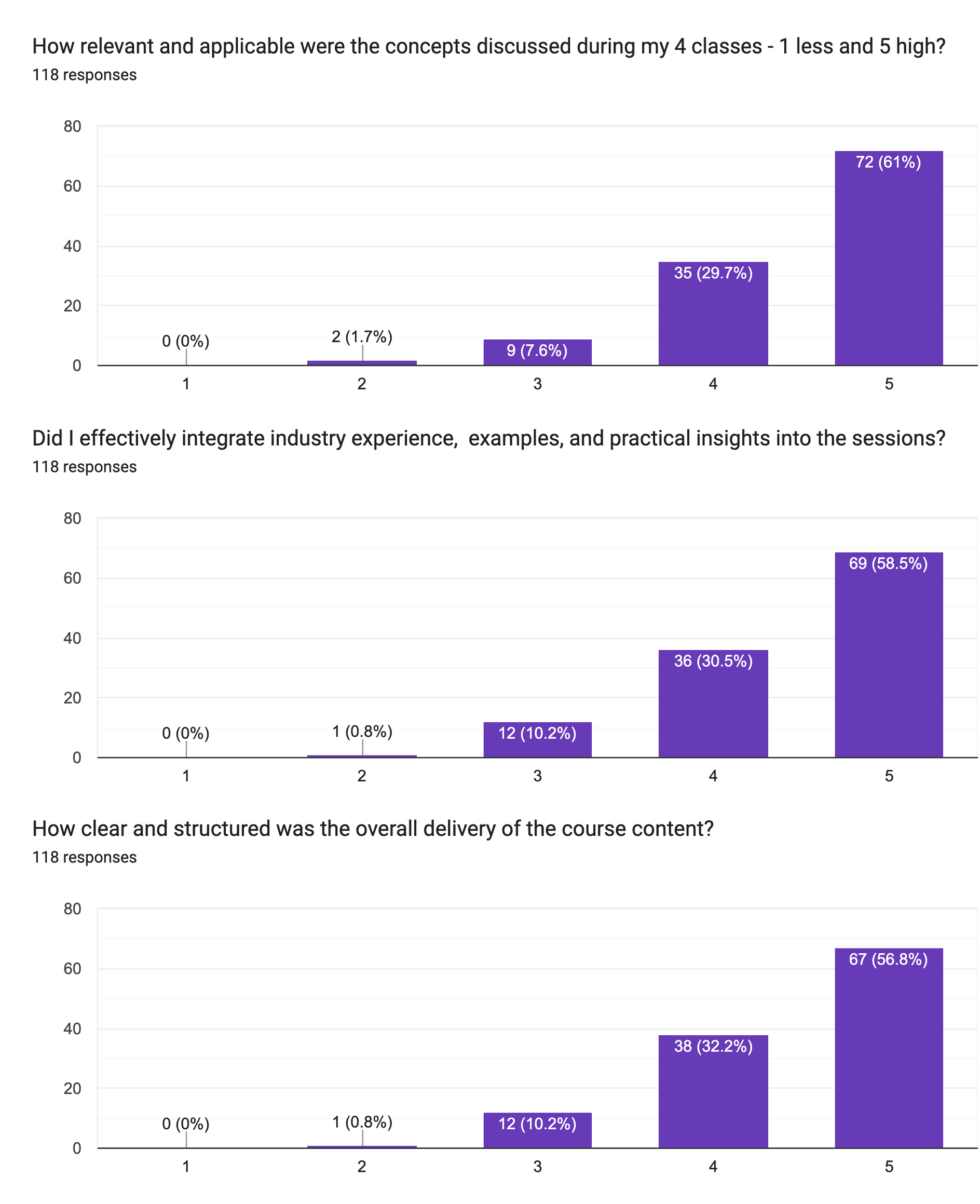
118 students’ feedback on my recent teaching assignment
I teach because the B2B industry - responsible for over half of global GDP remains underrepresented and under-taught in management education. Despite its scale and complexity, B2B Go-To-Market strategy is often approached in an unstructured, tactical way, and most management programs focus far more deeply on B2C marketing than on B2B GTM and execution. As a result, many young managers either avoid B2B GTM roles altogether or enter them without the strategic and practical grounding needed to succeed.
My objective is to bridge this gap by combining strong theoretical frameworks with real-world field experience, and by creating experiential learning through classroom instruction, expert sessions, and case-based discussions that prepare students for the realities of B2B growth and execution.
WHAT I TEACH
B2B GO-TO-MARKET STRATEGY & EXECUTION
This course is designed specifically for MBA students preparing for careers in B2B leadership, sales, marketing, and strategy roles. It provides a practical, end-to-end understanding of B2B Go-To-Market strategy—covering target market selection, value proposition design, pricing, sales and partner models, and multi-channel marketing—areas often underrepresented in traditional management curricula.
With a strong emphasis on real-world execution, the course blends proven frameworks, case studies, and hands-on tools to help students translate strategy into results. By focusing on disciplined execution and the impact of digitalisation and AI on B2B GTM, the course equips MBA graduates with the confidence and practical skills needed to succeed in complex, high-impact B2B roles.
EXAMPLE OF COURSE TOPIC OUTLINE
The course topic outlines uses practical, connected modules that mirror real B2B go-to-market work. It starts with channels—how direct and indirect networks (distributors, resellers, system integrators, alliances) are set up, managed, and used to scale reach. Next is B2B marketing—value-based messaging, persona-driven demand generation, partner co-marketing, and ROI-focused choices in complex buys. Then pricing—value- and outcome-based models, partner economics, and how data and AI improve pricing. A supply-chain module shows its impact on GTM execution, customer experience, and differentiation. The final module on technology ties these topics together, showing how digital platforms, data, and AI change marketing, sales, partner, and customer-success work. Together, the modules give MBA students an actionable, execution-focused view of B2B GTM so they can deliver results from day one.